Edible Fall Fungi Named After Fowl
I am swimming across the Lake. It’s medicine for my body and soul. Each stroke and breath is a releasing; an easing out of stress like shedding a skin. My mind calms and opens space for new thoughts. “Pop! Aha!” And so, this article was born…

I love foraging for wild edibles. It makes me feel more deeply connected to the land and to the season. And in the fall, among the flora I harvest, I love to hunt for fall fungi. In this article I will address 2 edible native autumn polypore mushrooms named after domestic fowl: chicken and hen. A polypore is fungus in which the underside of its fruiting body (aka a mushroom) has pores from which its spores are released. The pores look like tiny holes dotting the entire underside of the mushroom.
As an adage goes, “There are old mushroom hunters and there are bold mushroom hunters but there are no old, bold mushroom hunters.” Therefore, following a few important guidelines will help you become an old mushroom hunter:
- Always pay close attention to all identifying features. Don’t figure “it’s close enough.”
- Always do a spore print. Place 2 caps of the same specie underside down on two pieces of paper – one white and one black – to assess spore color. If the spore print is supposed to be white you will notice that on the black piece of paper.
- Anything is edible – once. If you are not sure of the species even after the spore print, do not eat the mushroom. Do not take the chance with your health or life.
- Always cook mushrooms. Do not eat them raw. Edible and medicinal mushrooms have a wide variety of health benefits but only if prepared correctly.
- Just because your friend ate an edible mushroom doesn’t mean you are or are not sensitive to it. As with any food, when you are first introducing your body to a new food, only eat a little of that new food and wait 24 hours. If your body experiences no complaints, you are good to go for the next culinary adventure.
Fowl Fungi
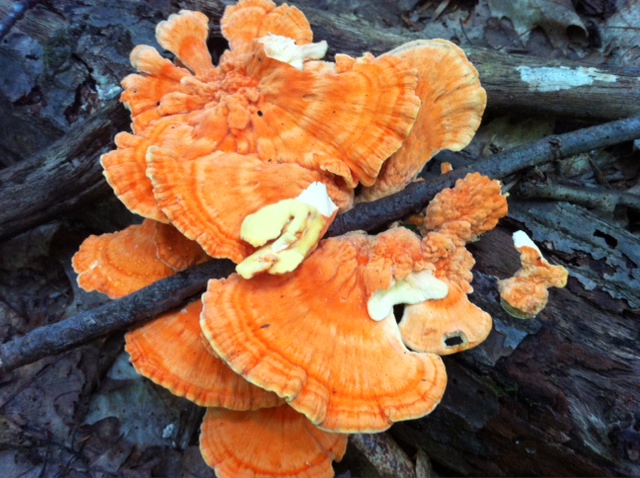
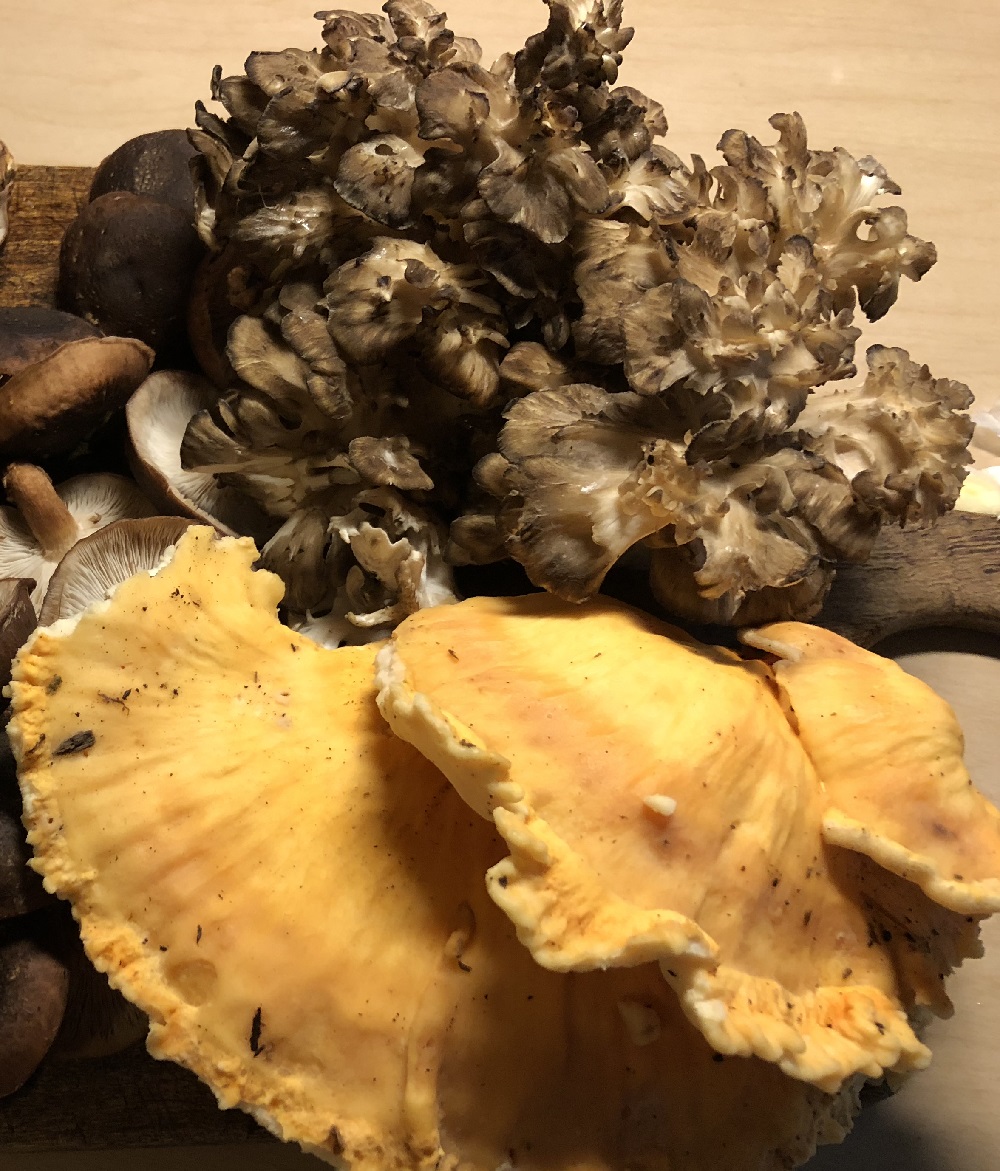
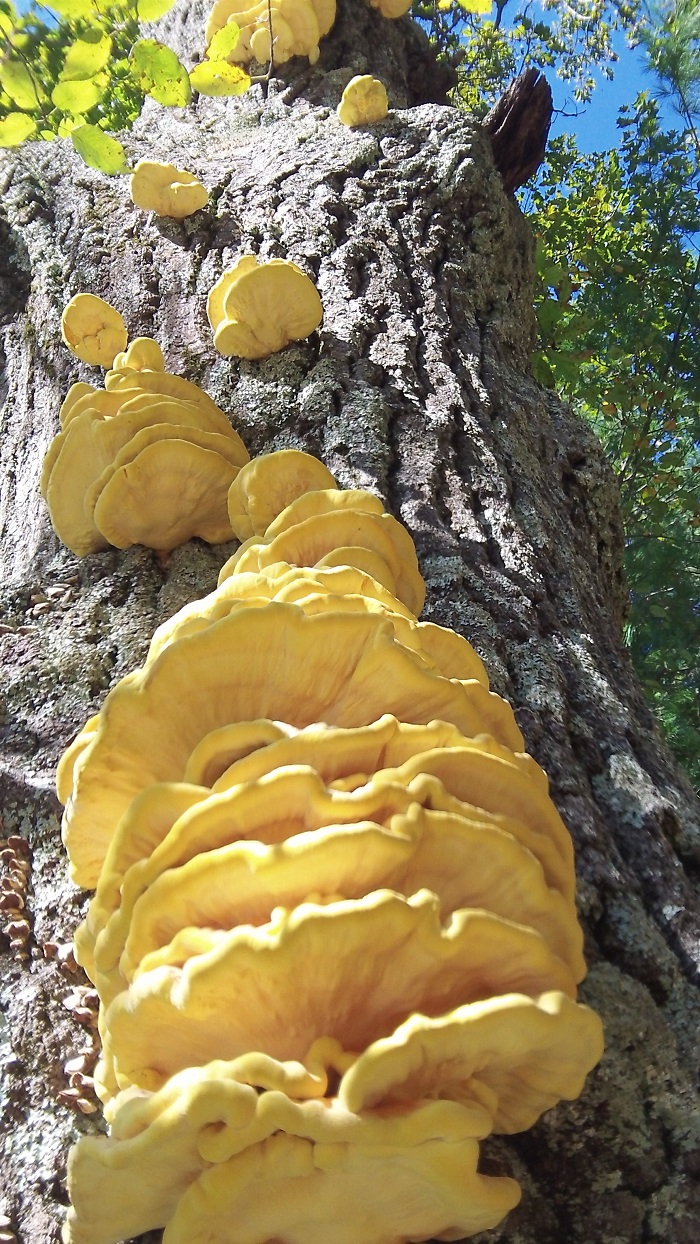
Chicken-of-the-Woods Laetiporus sulphureus and L. cincinnatus is a very noticeable fall fungi growing up and along the base of living or dead oaks or some other deciduous trees in dense clusters. There is also L. huroniensis which prefers to grow on conifers. All 3 varieties of chicken have pores producing a white spore print. L. cincinnatus’ capis salmon-colored and the underside is peachy-white. L. sulphureus has fruiting bodies that are bright orange in the center lightening to bright yellow at the edges. The underside is bright to light yellow. Chicken is a thick fan-shaped mushroom, up to 1” thick, with each cap growing anywhere from 2-20” in diameter. The stem or stipe is short and broadly attached to the cap. Ki has a pleasant earthy scent. When slicing Chicken, you may think you are slicing cooked chicken meat, as this mushroom is “meaty”.

Sauté fresh or freeze for later use. I just bag caps raw and put them in the freezer. After freezing defrosted caps will be more mushy but still tasty. Chicken can bloom May through October, though I mainly find them in the autumn. Chicken has properties that are anti-inflammatory, anti-microbial, anti-allergenic, and antioxidant. I love adding Chicken-of-the-Woods to stews, pizza, and stir-fries.
There is one toxic “look-alike” and I put this in quotations because although from a distance Jack-o-lantern has that same orange color, as soon as you get close, you will notice their flatter cap and if you turn the mushroom over, Jack-o-lantern has gills instead of pores.

Hen-of-the-Woods aka Maitake (which means “dancing mushroom” in Japanese) Grifola frondose grows 1-3” fan-shaped caps forming rosettes at the base of living or dead oaks. Hen may also pop up at the base of other deciduous trees such as beech and yellow birch. Rosettes, looking somewhat like a sitting bird by the same name, can grow rather significant – over 2’ in diameter. The top part of the cap may be beige, brown and/or grey. The underside will be white or cream with pores. The stipe and branching system may remind you of cauliflower. The spore print will be white. Hen tend to be available for harvesting later August through October. When the flesh is firm it’s good for collecting. As the mushroom ages, caps will lose their firmness and crumble more easily. Hens can be sautéed fresh or dried or frozen for winter use. When drying, separate and either put in a dehydrator at 110-110°or on racks above a warm wood stove, and when caps are thoroughly dried, place loosely in a glass jar, close the lid, and store for later use in making soups. stir-fries, and tea. When dried you can also pulverize the caps into a powder to flavor meats, stews, dips, and tea. Hen is a healthy source of vitamin D2 and also helps to regulate one’s immune system, lower cholesterol and blood glucose, and is an anticarcinogen against breast cancer, bladder cancer, and renal/kidney cancer. There’s quite a bit of research on Maitake so feel free to look up all the health benefits for proper preparation.
Both polypore fungi are saprophytes, which means that they derive their nutrients by “eating” dead and decaying matter. They are important decomposers in the forest ecosystem. They can also be mildly parasitic on live trees. But don’t worry – they don’t kill their host. You can find them growing year after year on the same trees. I mainly find both Chicken- and Hen-of-the-woods growing on dead, dying, or very old live Red Oaks.
Some great references to learn more about Chicken- and Hen-of-the-woods and other wild edible and medicinal mushrooms are Mushrooms of the Northeastern United States and Eastern Canada by Timothhy J. Baroni, Edible and Medicinal Mushrooms of New England and Eastern Canada by David L. Spahr, and Learn Your Land videos (on YouTube) by Adam Haritan.
Consult your local live mycologist for more details on proper meal and medicinal preparation of any edible fungi you find. Happy foraging this fall!

Arianna Alexsandra Collins, naturalist, poet, writer, wild edible enthusiast, and Wiccan High Priestess lives in Ashfield, MA.

This article appears in the September 2023 edition of The Ashfield News.
Like Offerings for Community Building on Facebook to learn more about wild edible and medicinal flora and fungi and recipes to incorporate wild foods into your meals.
Visit Offerings for Community Building for rates and packages on having a wild edible and medicinal flora and fungi inventory conducted on your Land (in New England).
Like Hearken to Avalon on Facebook and learn more about the magical world and natural history of plants and the Faie, and human interactions with them.
Resources:
- Mushrooms of the Northeastern United States and Eastern Canada by Timothy J. Baroni
- Chicken Of The Woods – Identification, Look-Alikes, Medicinal Benefits, & More with Adam Haritan
- Hen Of The Woods (Maitake, Sheep’s Head) Mushroom Identification & Health Benefits with Adam Haritan
- Learn Your Land with Adam Haritan
- Edible and Medicinal Mushrooms of New England and Eastern Canada by David L. Spahr
 Hearken to Avalon