Native Edible Winter Groundcovers: Wintergreen and Partridgeberry
“Red and green together be seen in the dark time of the year. Oh, red and green, together be seen to bring us hope and cheer.” ~ adaptation from Maddy Prior song
There are several edible persistent red berries providing vitamin C in wintertime. In prior articles I have gone over Rose, Japanese Barberry, and Staghorn Sumac. In this article I will cover two native groundcovers – Wintergreen and Partridgeberry.
Remember the taste of Wint-O-Green Life Savers? In addition to the minty flavor, you could crunch on this hard candy in the dark and your mouth would light up from the friction of sucrose on your teeth. That process is called triboluminescence. Well, that minty flavor, before the addition of artificial flavors, comes from methyl salicylate, an organic liquid compound and volatile oil naturally occurring in such flora as Black Birch, Yellow Birch (read my article on Birch HERE) and in Wintergreen.
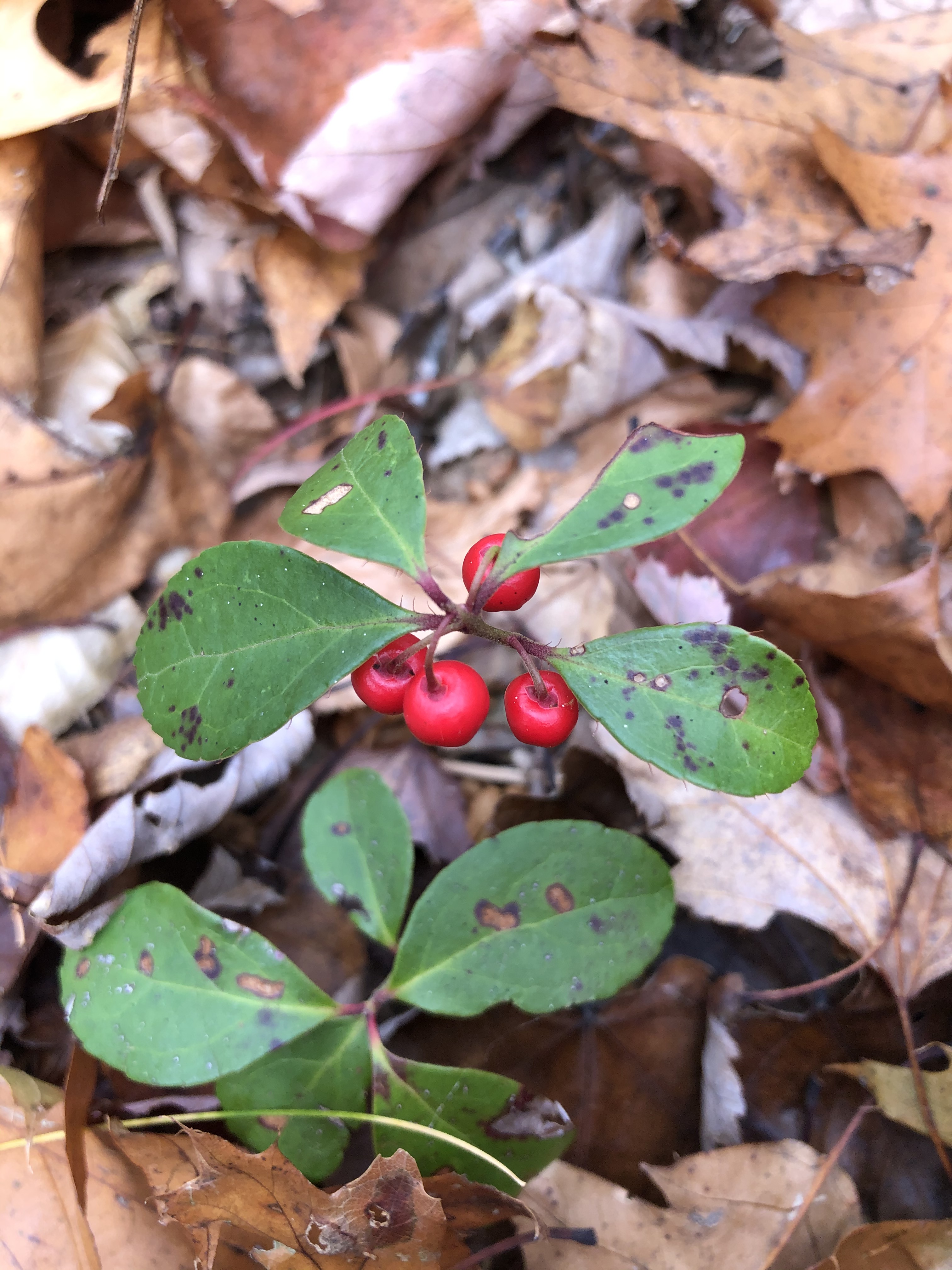
Wintergreen, Gaultheria procumbens, is a creeping woody woodland evergreen groundcover in Ericaceae – the Heath or Heather family. Other common names include Teaberry, Checkerberry, and Boxberry. Both the leaves and berries contain methyl salicylate, which is an analgesic and closely related to the compound found in Willow (salicin) from which we made aspirin (salicylic acid).
Breath-mint anyone? Walking a woodland trail and need a little something to freshen your breath? Eat a few Wintergreen berries or chew on a leaf. While a medicinal dose is good for digestion – such as 1 cup of tea – as the saying goes “too much of a good thing” is apt here as eating too many of these methyl salicylate containing berries can lead to a stomach ache – so eat no more than a small handful at a time, either by themselves or tossed into a fruit salad or crushed and used to flavor ice cream. They can also be cooked as part of a fruit compote. Leaves can be torn or crushed and used to make tea. As with any flora containing volatile oils, steep in nearly boiling water and cover over 10 minutes before consuming. You can also make an oil from the crushed leaves and apply as a topical pain reliever and anti-inflammatory. You have to plan for this because to make an infused oil you need to steep the plant matter for 4-6 weeks in the oil, gently rolling and turning each day to be sure the crushed leaves stay covered in the oil. Wintergreen can also be used as one of the ingredients in an herbal digestive bitter, as a mouthwash, and to flavor homemade toothpaste. It is not recommended to use Wintergreen during pregnancy as the compounds stimulate the uterus. Do not give to cats as methyl salicylate is toxic to them.
Fruiting in the fall, the red berries can persist through the winter. They drupe singularly below the leaves. One stem will branch 3-5 leaves. Green leaves are broad, shiny, leathery, and elliptical with tiny widely-spaced teeth. Young leaves may appear reddish-green and some green leaves will turn red-purple in the fall. I find Wintergreen in mixed deciduous conifer forests, especially moist but not wet woodlands, with Eastern Hemlock scattered about. Wintergreen also appreciates living close to other Heath family members such as Rhododendron and High-Bush Blueberry in slightly acidic soil.
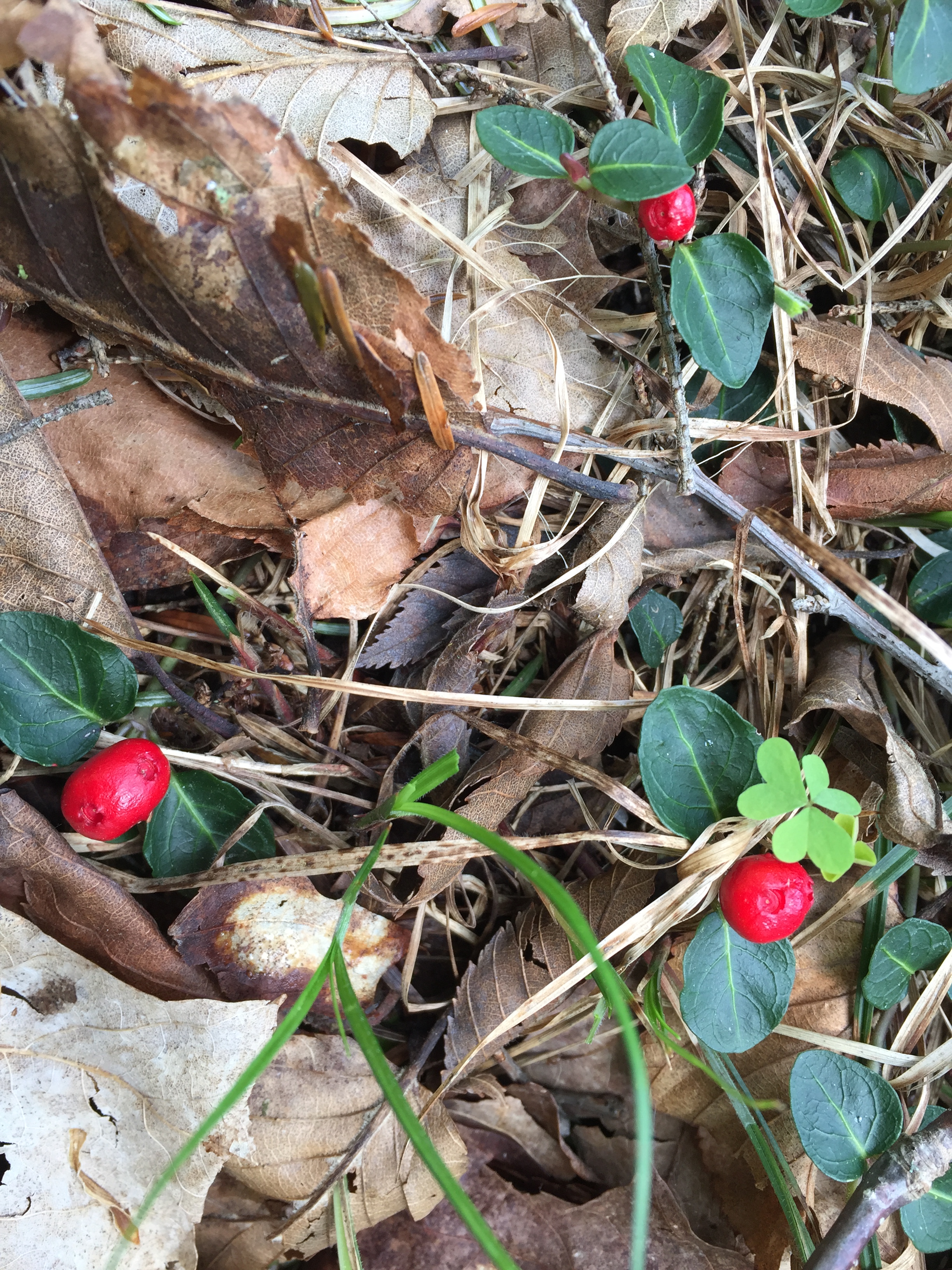
Another groundcover producing red berries in the fall is Partridgeberry, Mitchella repens, in the Madder family. The red berries, while edible, I do not find overly flavorful, but like other edible red berries are high in vitamin C. So, if you think you found Wintergreen but the berry has a mild to slightly tart flavor, you probably found Partridgeberry instead. You can eat the berries raw in a green or fruit salad or use the berries in baked goods. There is some evidence of Partridgeberry containing abortifacient properties so if you are a pregnant person wishing to remain so, best not to eat the berries. Medicinal uses of the leaves do include bringing on delayed menstruation and stimulating childbirth.
Partridgeberry is a woody creeping vine that does not climb but carpets woodlands, especially Fir and Beech dominant, though I also find them quite happy near, but not under Eastern Hemlock and in woodlands close to a lake. Like Wintergreen, Partridgeberry also has broad evergreen leaves, but this flora’s leaves are quite small, occurring opposite, and fairly easy to tell the difference from Wintergreens’ bigger, broader, more leathery-looking leaves. You can find both in the same habitats. Partridgeberry has white, paired, trumpet-shaped flowers blooming mid-summer and Wintergreen has pink-white bell-shaped flowers blooming June to August.
And speaking of partridges, according to the Audubon Society, the Grey Partridge was brought over as a game bird from Europe in the 1790s into the northern mid-west to northwest of the USA and into Canada. But here in New England you will not find any partridges in pear trees (or any other trees), nor eating Partridgeberry. So, who eats these red berries? Ruffed Grouse, Turkey, White-Tailed Deer, Skunk, White-Footed Mouse, Raccoon, Red Fox, Grey Fox, and Human.
And if you are seeking to put in a forest garden or want a groundcover for your edges, consider planting native flora instead of invasive plants. Support our Native Plant Trust by purchasing from them or with neighbors who may have enough to share.
Enjoy all the beauty and treats winter has to offer. Happy foraging.

Arianna Alexsandra Collins, naturalist educator, poet, writer, wild edible enthusiast, and Wiccan High Priestess.

An edited version of this article appeared in the January 2026 edition of The Ashfield News.
Like Offerings for Community Building on Facebook to learn more about wild edible and medicinal flora and fungi and recipes to incorporate wild foods into your meals.
Visit Offerings for Community Building for rates and packages on having a wild edible and medicinal flora and fungi inventory conducted on your Land (in New England).
Like Hearken to Avalon on Facebook and learn more about the magical world and natural history of plants and the Faie,
 Hearken to Avalon