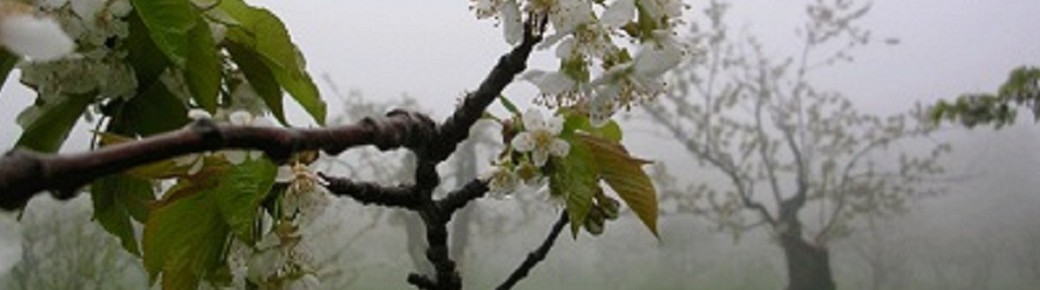
Leaves of three let them be but maybe not always
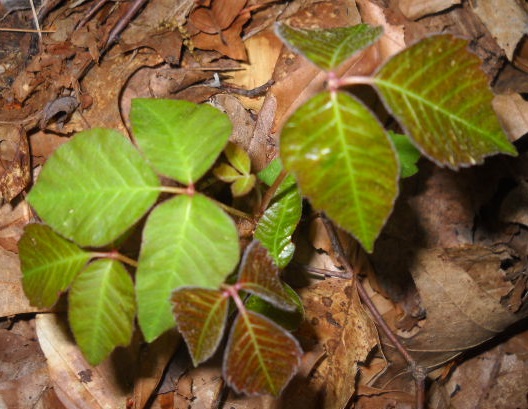
“Leaves of three let them be.” Who has been warned about Poison Ivy in this way? Though it could be a good primer, generations have grown up being concerned to get near any plants with three leaflets. By fearing “leaves of three” you may be missing out on edible Toothwort and Wild Strawberry to name just two. In my wild edibles programs, I have actually had participants leap back when I am asking them if what I am pointing to is Poison Ivy. The fear around this plant is incredible. Yes, it is very unpleasant to downright dangerous if you have a bad reaction. People who have accidentally burned the vines along with other wood and breathed in the smoke needed immediate emergency care. But simply bending over to observe this plant is fine to get to know ki better. Poison Ivy is not going to reach up and swat you. However, if you step on the woody stem, the stem will spring back – so don’t be in the way – because, if a leaf or stem breaks and the sap oozes out and gets on you, that sap contains urushiol, the compound responsible for giving humans that red weeping itchy rash. You can get a Poison Ivy rash any time of year because the woody stems and vines are present all year. And just because you haven’t had a reaction before does not mean you are immune.
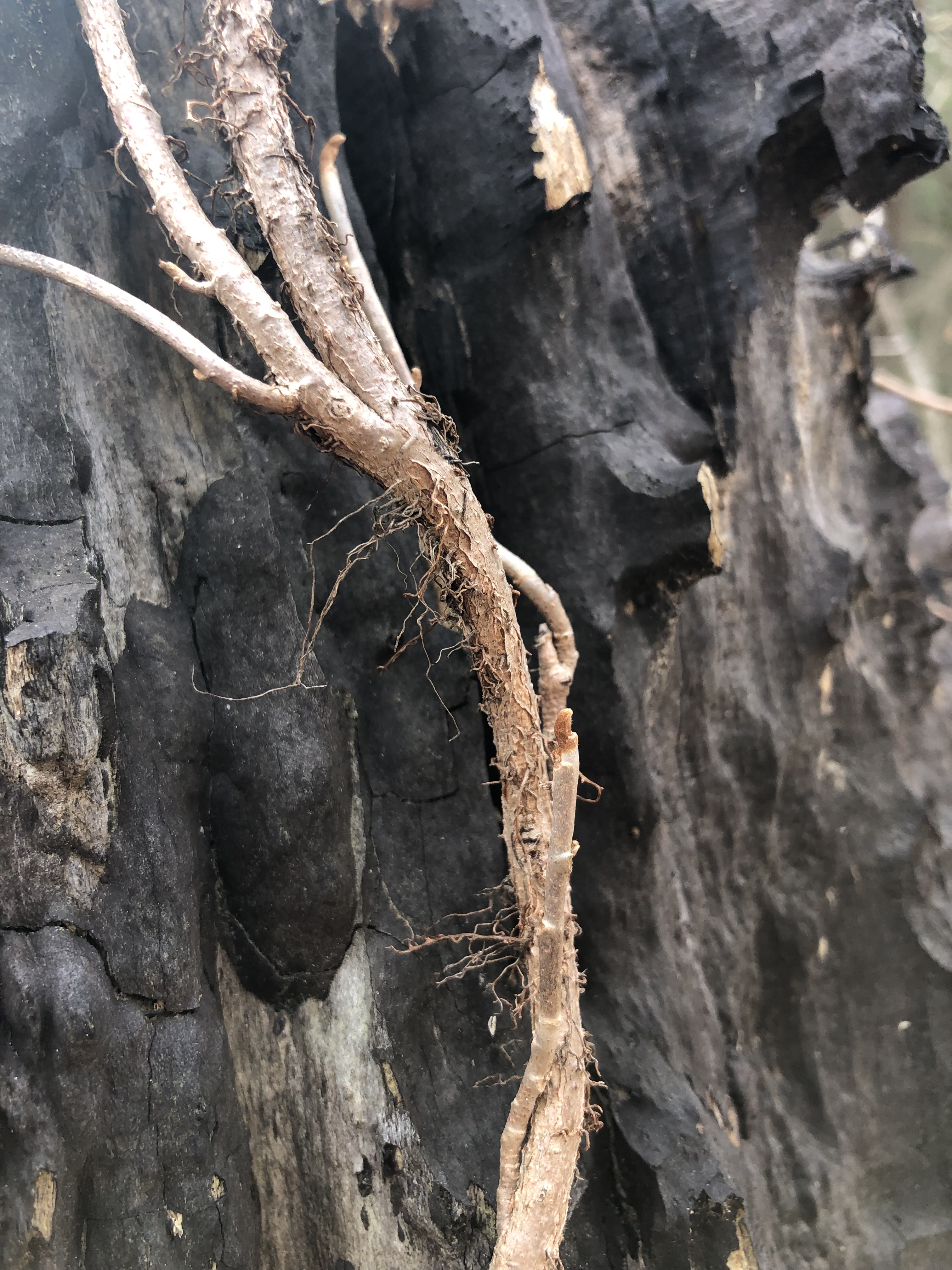
So, let’s get to know this plant better. Poison Ivy Toxicodendron radicans is a native woody plant growing both on the ground and as a brown woody hairy vine growing up trees. Poison Ivy is in the Cashew family (Anacardiaceae) and is not a true ivy. Some members of Anacardiaceae are edible and others most certainly are not. For example, Staghorn Sumac berries are edible but Poison Sumac are not. However, if you have a Cashew allergy, you probably can’t eat the edible Sumac.
Poison Ivy stems are generally light brown when young and are wiry. You may or may not notice the hairs on new stems or vines so look closer without touching the stem so that you can see the wiry hairs jutting out. As stems and vines age they get hairier. Young leaves are generally bright red and shiny. Leaves green up as the season progresses and tend to lose any shininess they had. But the leaves do always come in threes – a three-leaflet structure. AND those leaflets can be hard to pin down on one description, because their ovate leaves can be slightly lobed or toothed or smooth. No wonder folks get so confused – Poison Ivy is a great mimicker and can blend in with all the other woodland and edge flora. If you see flora with three leaflets your next task is to look more closely at the three-leaflet structure and the stem. Poison Ivy’s three-leaflet structure has one “head” leaflet with a longer stem and then two opposite leaflets with small stems. That is unique to Poison Ivy.
Now to take your knowledge and apply it in the field.
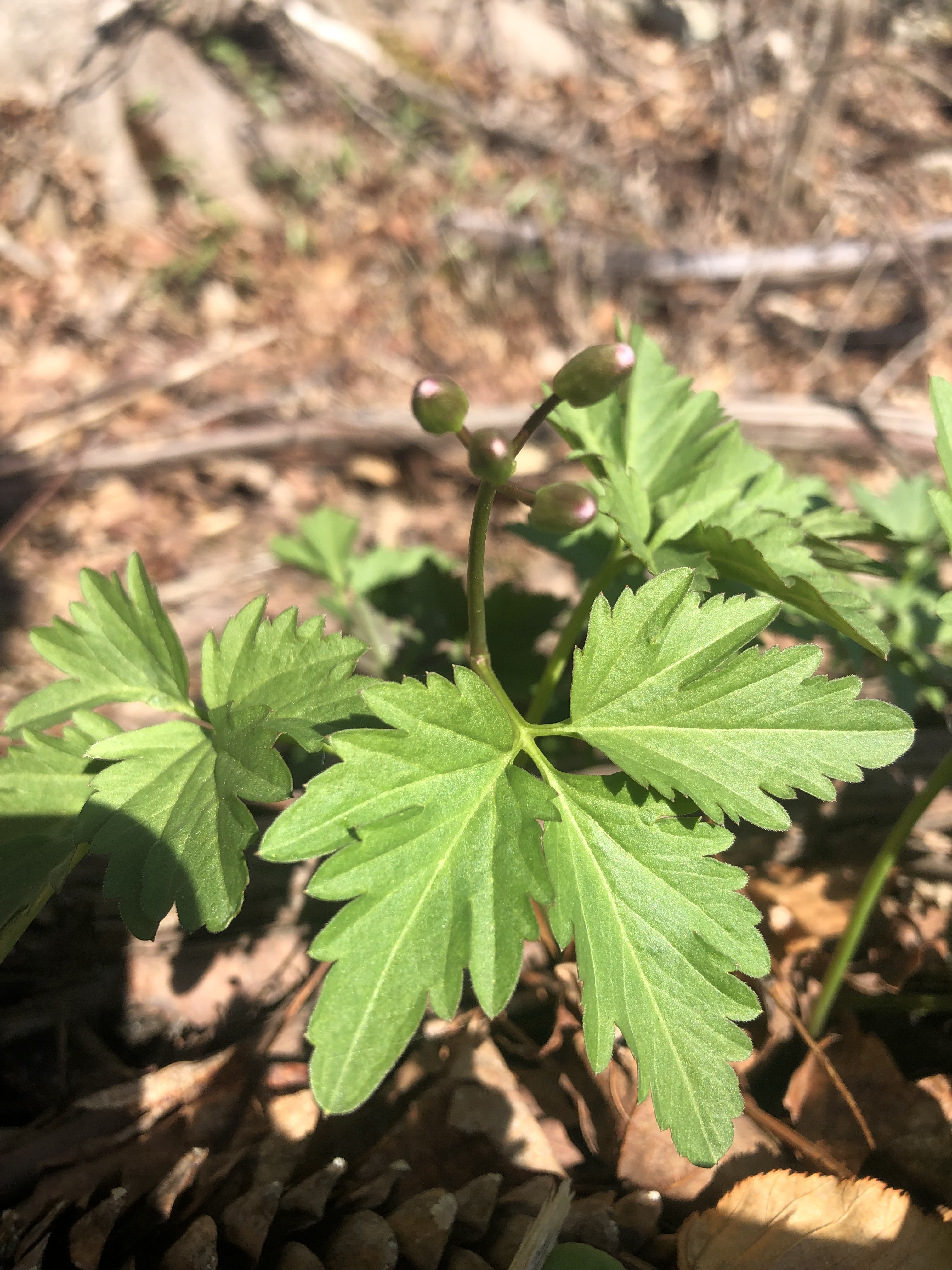
You are gazing at a three-leaflet plant that you just found on the side of the road in a partially shaded stream. You step closer and notice the three-leaflet structure has a smooth stem. Your first clue is that this flora likes having wet “feet.” Poison Ivy does not. Your next clue is that this stem is smooth. Poison Ivy never has a smooth green stem. And given it is May, you will also notice this flora’s small white four-petaled flowers dangling off a smooth stalk. This is the spring ephemeral Toothwort. By mid-May the aerial parts of this plant will disappear. But while this spring ephemeral is up, break off a leaf and crush it. If it is Toothwort, there will be a pungent scent. Take a nibble and you will taste a horseradishy bite. Toothwort Cardamine concatenata is a member of Brassicaceae, the Mustard family, and is related to Brussel Sprouts, Broccoli, and Horseradish. All parts of Toothwort are edible. If you don’t eat the root – which is shaped reminiscent of a tooth, the plant can continue to come back year after year. Collect a few leaves and flowers from each clump you find so as to avoid overharvesting this native species. Toothwort has a fun “wake-up your mouth” taste and can be eaten raw in a salad. I also enjoy including them in a springtime omelet or baked into a souffle with other edible spring ephemerals. Note, depending on the variety of Toothwort you found, the leaflets may be deeply toothed or scalloped.
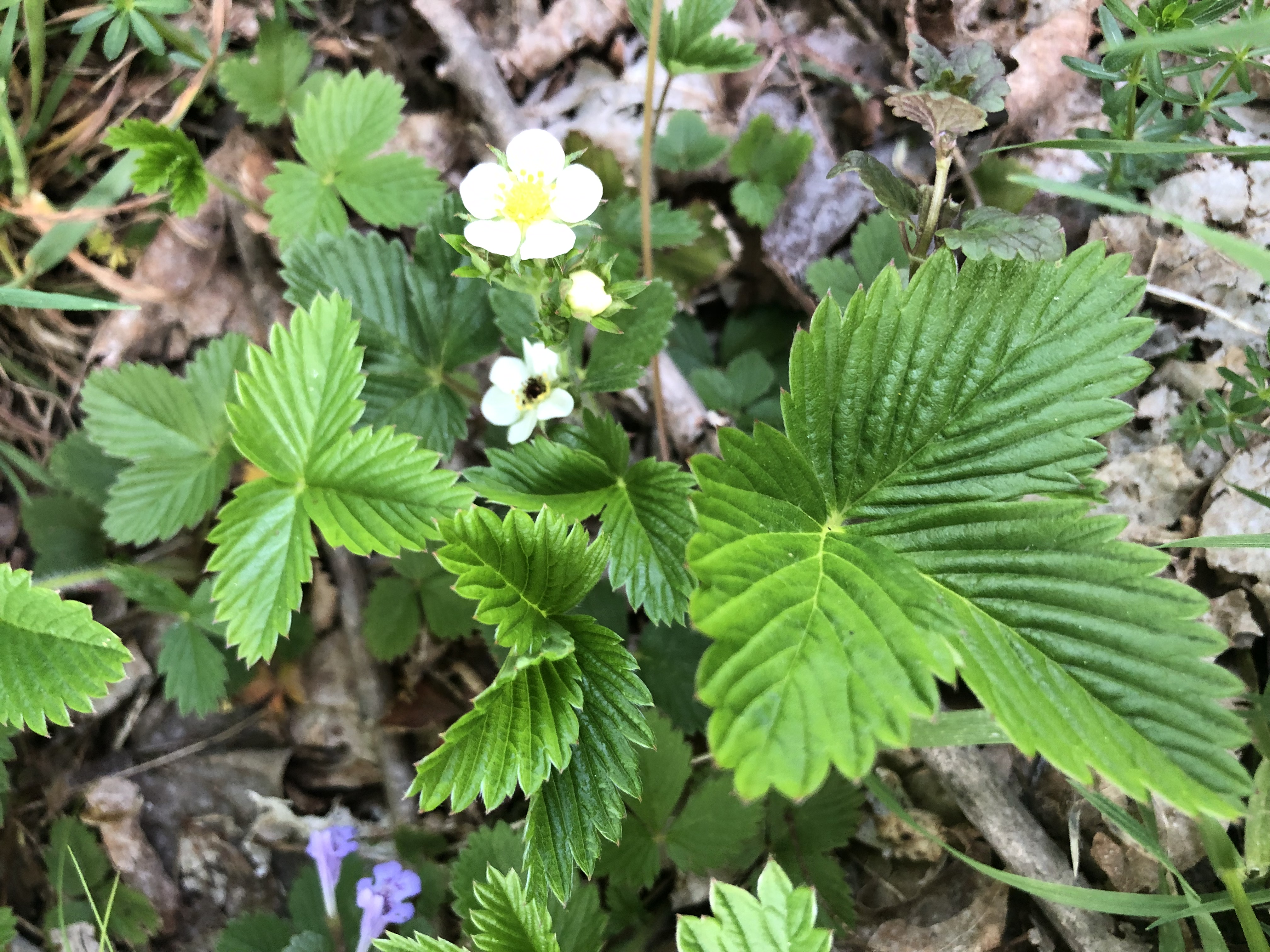
As you continue your walk, you find yourself on the edge of a field. This next three-leaflet plant you come across has deeply veined, wavy, toothed green leaflets that are fuzzy on the underside. The leaflet structure appears compact and all the petioles of the leaflets are of equal length. Honing in on the stem, you notice it is fuzzy, not wiry. You also observe this plant has a hairy, but not wiry, runner, leading to a developing plant – this is primarily how Wild Strawberry propagates, as the actual yellow seeds on the outside of the red berry are not strong germinators. And because this is May you also spy a white five-petalled flower with a yellow center. Take note of the site and come back in mid-June to see if there are little red berries that look like miniature versions of the strawberries you buy in the store. Native Wild Strawberry (Fragaria virginiana) fruit smells and tastes like what they are – strawberries. But then there is the introduced Mock Strawberry (Potentilla indica) heralding from southeastern Asia. Note, their flowers are yellow. Mock Strawberry berries are also red and are also edible but apparently are rather bland. Wild Strawberry berries, dangle whereas Mock Strawberry berries are erect off the stem. Both floras are in Rosaceae – the Rose family. Wild Strawberries are full of antioxidants and contain vitamins C, B and E. And their leaves are edible too. You can eat raw or as a tea to treat digestive complaints and diarrhea.
When you take time to notice all the similarities and differences between floras you can learn to distinguish who is edible (and in what season) and who is not.
Happy foraging!

Arianna Alexsandra Collins, naturalist educator, poet, writer, wild edible enthusiast, and Wiccan High Priestess.

An edited version of this article did NOT appear in the May 2025 edition of The Ashfield News.
Like Offerings for Community Building on Facebook to learn more about wild edible and medicinal flora and fungi and recipes to incorporate wild foods into your meals.
Visit Offerings for Community Building for rates and packages on having a wild edible and medicinal flora and fungi inventory conducted on your Land (in New England).
Like Hearken to Avalon on Facebook and learn more about the magical world and natural history of plants and the Faie,
 Hearken to Avalon
