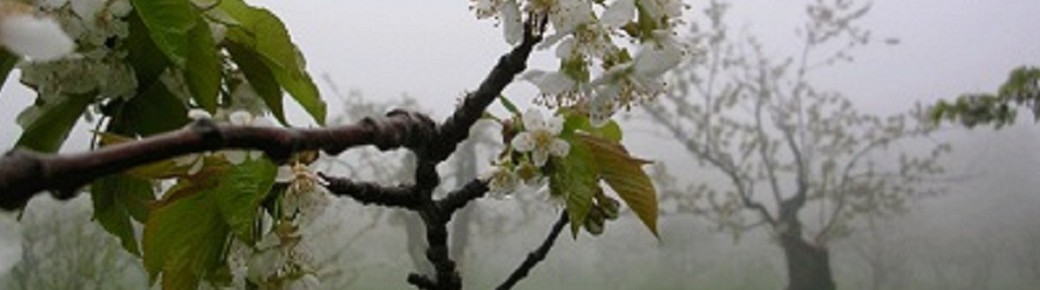
Wait I can eat that? Flowers People Are Surprised They Can Eat

It’s Summer Solstice and I am delighting in the taste sensations that the change in season brings. Rugosa Rose. Ox-eye Daisy. Daylily. Red Clover. Steamed Milkweed flower buds.
Whether I am facilitating a wild edibles workshop or bringing a salad to a potluck, there is almost always at least one person who states, “Wait, you can eat that?” I love sharing my passion for free foraged food. “Yes,” I gleefully respond!

There is such an abundance of flora and fungi that are available to us for consumption. So many flowers to be shared. And many that folks readily know can be consumed such as Dandelion, Red Clover, and Nasturtium. But then there are those flowers that have been almost forgotten that they are also edible. In April it was Toothwort, Marsh Marigold and Forsythia. In May it was Lilac and Grape Hyacinth. In June and July it’s Ox-eye Daisy, Pineapple Weed, Wild Carrot (Queen Anne’s Lace), Evening Primrose, and Milkweed (note: Milkweed must be steamed or boiled 6+minutes before eaten.) Several of these flowers I have written about in previous articles. (Go to HearkentoAvalon.com to read them.)
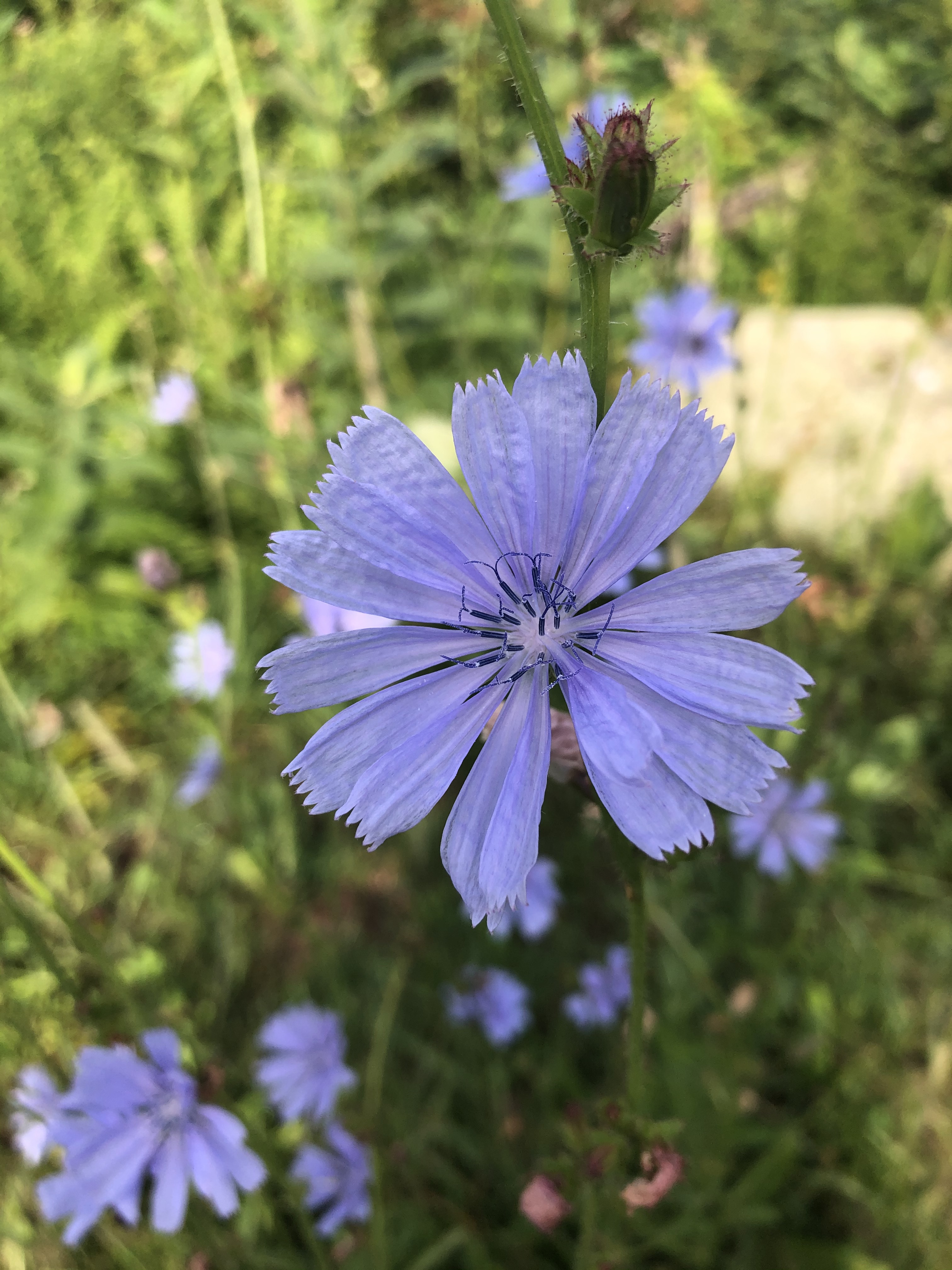
Today I am going to share a bit about Chicory. Cichorium intybus in Asteraceae is a “somewhat woody” herbaceous perennial who heralds from Europe and was brought over to North America as an edible, mainly for kins roots and leaves. You may know that the root is edible and used as a Coffee substitute. Note: don’t drink Chicory as a substitute for another beverage you crave; you will be disappointed. Instead drink Chicory root for itself. Like Coffee, Chicory is a bitter and you may develop a taste for ki. In addition to the root did you know that the flowers are also edible? You can eat them raw. Flowers are bright blue growing individually up spindly stiff stems. When the flowers close up in the evening, the plant can look somewhat on the edge between life and death. And then suddenly, the next morning, the flowers open and the plant looks vibrant again. The petals are reminiscent of miniature “sporks” having little teeth at the ends. And in the center the stamen and style look like a circle of long antennaed beings having a conversation.
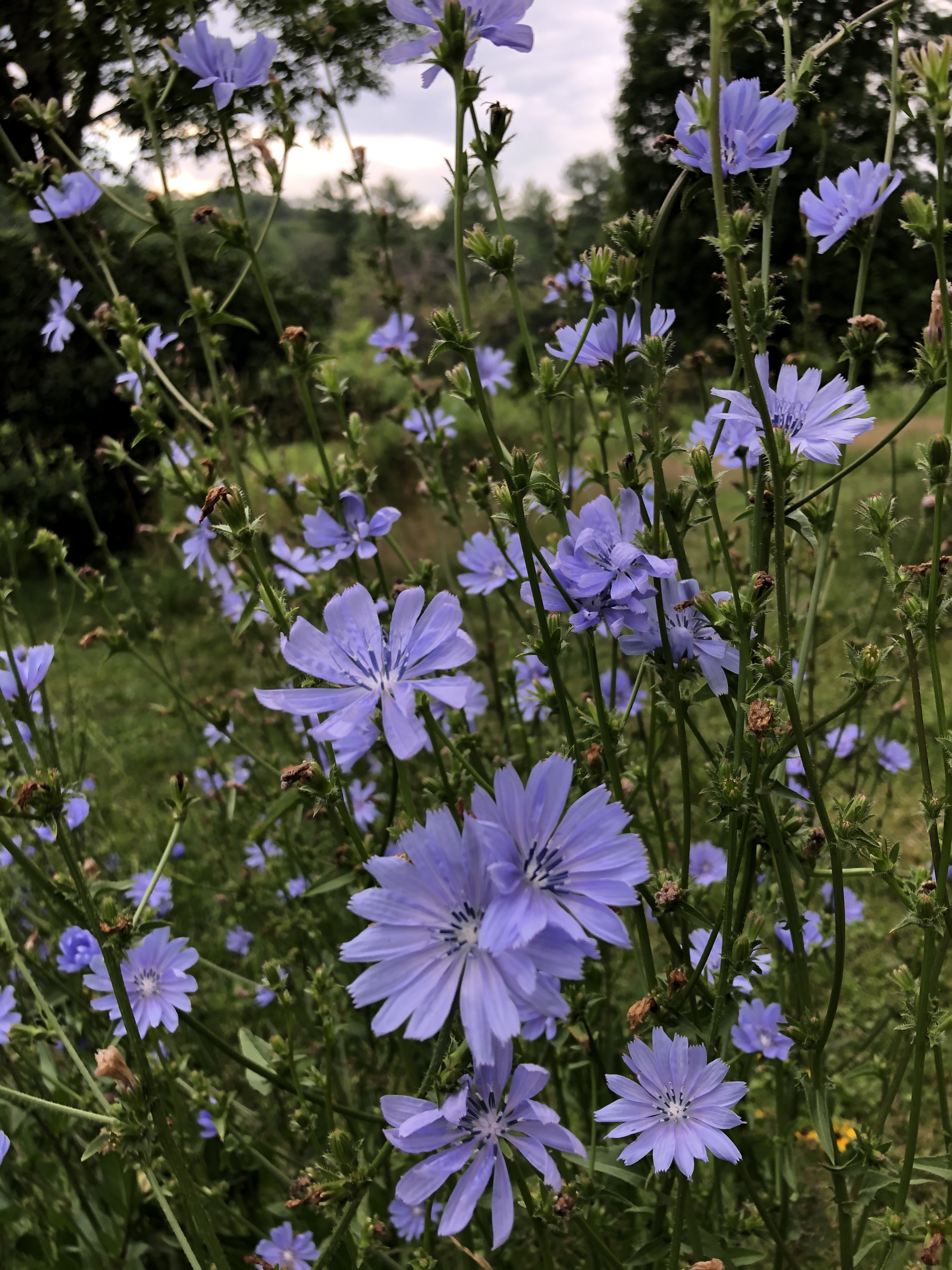
I had a “wait, you can eat that?” moment when I was looking up Chicory’s Latin name. I knew that the root is edible because for years I had been seeing the root in the food co-ops’ herbal bulk section. And then I learned that the flowers are edible and have been eating them for a few years. But I didn’t know that the leaves are also edible both raw and cooked. The basal leaves look somewhat like large hardy spinach leaves surrounding a thick stem which thins in height. The leaves growing up the stem are much smaller and clasp the stem. At the top of the plant, the leaves are tiny. As with most herbaceous plants whose aerial parts are edible, when the flowers come into bloom, the leaves become tougher and more bitter. Some wild edibles enthusiasts consider Chicory flowers to be too bitter to eat. Compared to what? Sure, they are bitter, but I don’t think they are overly bitter, and they look so pretty in a summer salad. Also, bitter foods are good for the body. Bitters can support the digestive system.

As humans observed the changing seasons, we attempted to mark them into 4 neat quadrants: spring, summer, autumn, and winter (and if you live in New England, we have a decidedly fifth season – mud season). Given that flowers and fruits come into season at different times, there is not just, for example, summer. Summer is also divided up into weeks with the variety of garden, feral, and wild edible flowers who are blooming. My salads change on a weekly basis, as some flowers are coming into blossom or are in full bloom or are passing. So, we don’t have just four or five seasons, we have so many more. For example, Milkweed flowering season is in late June to early July. Chicory season starts in July. And Goldenrod season doesn’t start until late July.
While you are enjoying each week of summer you can call that week by who you are noticing in bloom to remind yourself which flowers are on the menu. Happy foraging and enjoy fresh beautiful salads with a multitude of edible flowers.
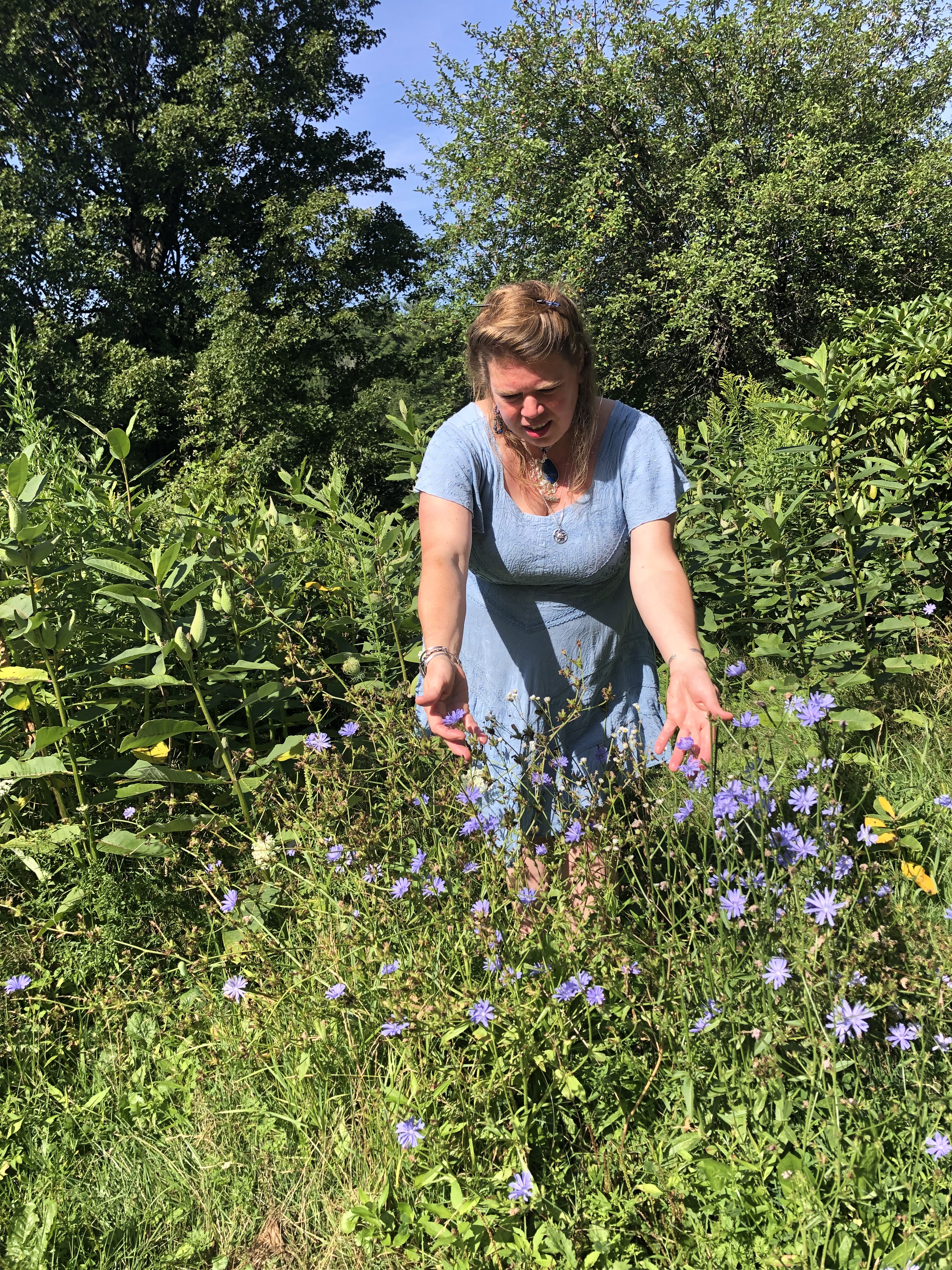
Arianna Alexsandra Collins, naturalist, poet, writer, wild edible enthusiast, and Wiccan High Priestess.

An edited version of this article appeared in the July 2024 edition of The Ashfield News.
Like Offerings for Community Building on Facebook to learn more about wild edible and medicinal flora and fungi and recipes to incorporate wild foods into your meals.
Visit Offerings for Community Building for rates and packages on having a wild edible and medicinal flora and fungi inventory conducted on your Land (in New England).
Like Hearken to Avalon on Facebook and learn more about the magical world and natural history of plants and the Faie, and human interactions with them.
Note: I am an advocate of sharing a grammar of animacy. Our non-human neighbors are not “its”. They may have no gender, no known gender, or more than 1 gender, but that does not make them an object. For this reason I use ki, kin, kins as pronouns which Potawatomi botanist and author Robin Wall Kimmerer coined. To learn more about a grammar of animacy and respect read my article Using “Ki” as a Pronoun for Nature.
 Hearken to Avalon