Burbling Bobolinks and Babbling Brooks
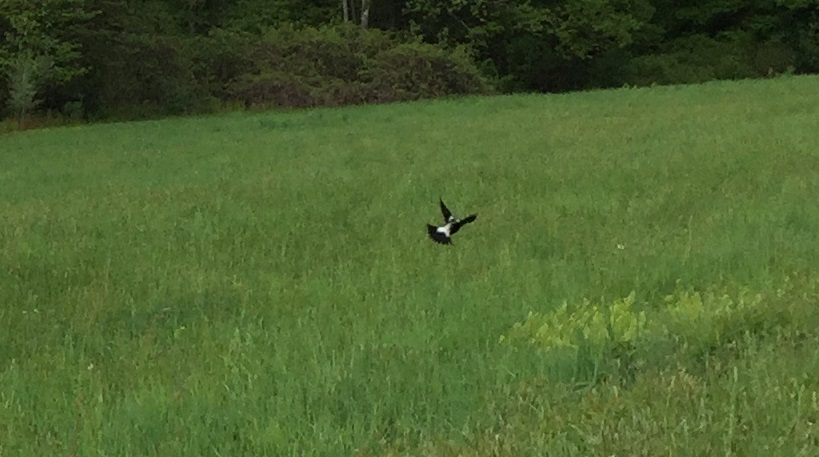
Perhaps late this spring you were gazing into the fields – I know I was – and a little fellow decked out in black and white caught your eye. He caught your eye because you heard his burbling song – that has been likened to our famous space-faring friend R2D2 – and followed it, then him, cascading down into the grass. But who is he and where did he go?
Bobolinks are field-nesting neo-tropical songbirds who make the tallgrass and meadows of northern North America and southern Canada their summer home and breeding grounds. In the spring they fly up from interior grasslands and marshes in South America, covering over 6,000 miles, to reach New England. Over the centuries, farmers’ hayfields have become their ideal habitat for raising their young. Males are conspicuous, sporting what appears to be a tuxedo on backwards, with a white back, black tummy and tail, and black wings with white stripes. His black head is donned with a yellow cap towards the back of his head. He sings and parades around on the breeze, while his female mate (or mates) dresses herself in camouflage of browns and tawny yellows to blend in with the herbaceous flora of the field. (Click HERE for id pics.) She will lay a clutch of 3-7 eggs and incubate them for about 2 weeks. As chicks are growing they feed exclusively on protein-rich invertebrates. Adults are omnivorous eating both seeds and invertebrates. Chicks fledge in early to mid-July. Now there’s the rub – our New England hayfields make great nurseries – unless the farmer hays the field before the babes can take flight. I have driven by newly mown fields in June, watching frantic males flitting about or perched on a fence post scanning, unable to find his family torn apart by the blades. It’s absolutely heartbreaking. But what is a farmer to do? They need to hay the field to feed their farm animals. There’s always a balance for farmers who are doing their best to make ends meet, attend to the farm animals in their care, and the wildlife who claim this space is home as well. If farmers can wait until mid-July to hay, that is ideal.
When I worked as a naturalist at Bonnyvale Environmental Education Center (BEEC) in Brattleboro VT, one of our late May into early June activities was to scout for Bobolinks with binoculars. We watched the males and paid close attention to where they stopped singing and disappeared into the tallgrass. My co-worker Deb and I would then quietly and carefully walk out into the field about 6-10’ away from where the male dropped down and steak out the area in hopes to protect that nursery. Because the hayfield was owned by BEEC with a neighbor using the field for hay and their heifers, the kindly farmer would mow around the places we had staked out. It certainly was not the most efficient way of mowing, and it made the field look like funny patchwork, but it did tend to protect these native field nesting songbirds. After he mowed, Deb and I would walk the field again to assess. We’d find Garter Snakes and Pickerel Frogs cut by the reaper, making food for the Crows, but we didn’t tend to find scattered feathers. I know everyone needs to eat but I still cried for my slithering and hopping neighbors.
Bobolinks are unfortunately still on the decline, mainly due to habitat loss. So while it’s vital we keep our farmers in business so that we don’t lose prime farmland to development, we also need to support farmers so that they can, in addition to farming, set aside some space for wildlife.
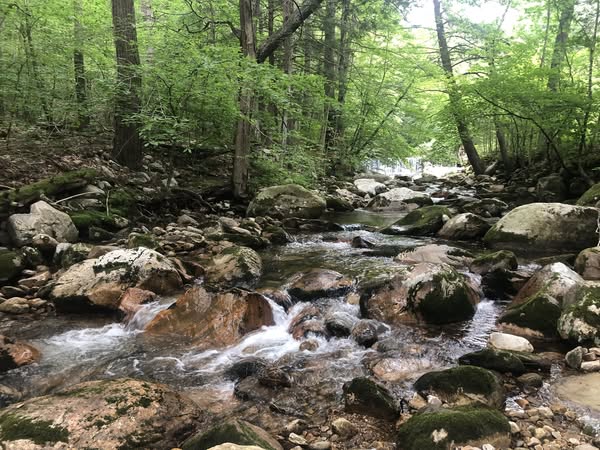
Moving from field to stream, our babbling brooks are home to an array of aquatic beings. By studying who lives there, we can determine the health of the waterway. Our native Brook Trout is one such indicator of a healthy highly-oxygenated cold stream. How do we help keep our streams healthy, which also means cold? By providing shade. Plant native shrubs and trees along streambanks. Fallen leaves add nutrients to the waterway for our herbivore invertebrates who are fed on by predacious invertebrates who then feed fish. Of course, this then creates attractive diners for Kingfishers, Great Blue Heron, River Otter, and Homo Sapiens.
If Brookies can reach the estuaries and the ocean, they will and then return again to their home spawning grounds. They also may only travel as far downstream as they can and back again. Both males and females sport an olive-green back marked with yellow spots. Toward the base of their sides, their coloring changes to orange-red with red spots. Their bellies are white. (Click HERE for id pic.)
A fish nursery is called a redd. Mating fish create beds of gravel and small stones with their tails in late autumn, then swim upstream to expel eggs and milt (sperm) to comingle and get caught in the redd. Brookies hatch in January! Who does that? It’s freezing. But these babies love the chill. Opportunistically feeding on any invertebrates they can catch in or out of water, they grow to 3-4” by their first summer. River-bound adults will reach 6-8” but up to 12” is possible.
Climate instability is creating all sorts of noticeable problems for both wildlife and humans. For example, when streams heat up to 20°C/68°F that will stress Brookies. They are no longer interested in feeding, and hence won’t go after your lures, because their primary objective is to find cold shelter. I understand that cause I appreciate cold water too. Cold water feels luxuriously silky and makes your body feel entirely alive. (Yes, I am one of the cold-water Sirens who you see in open patches of water during the winter.) As I mentioned earlier, we can help create those cold-water shelters by planting native trees along the banks to shade and cool the water.
So for both Bobolinks and Brookies, it is partially up to us to protect them by providing healthy habitat for them to grow and thrive. Thank you in advance for your care and consideration.
Arianna Alexsandra Collins, naturalist educator, poet, writer, wild edible enthusiast, and Wiccan High Priestess.

An edited version of this article appeared in the July 2025 edition of The Ashfield News.
Like Offerings for Community Building on Facebook to learn more about wild edible and medicinal flora and fungi and recipes to incorporate wild foods into your meals.
Visit Offerings for Community Building for rates and packages on having a wild edible and medicinal flora and fungi inventory conducted on your Land (in New England).
Like Hearken to Avalon on Facebook and learn more about the magical world and natural history of plants and the Faie,
 Hearken to Avalon